I Got Two Website Quotes and They're Thousands Apart. What Am I Comparing?

TL;DR
You may be comparing two different jobs. A price can’t show you that, but the answers to five questions can: what problem this solves, what happens to the site you have now, what will be in your hands at the end, what the first year asks of you, and where the price stops.
Send the same five questions to both people before you decide which number is right. There’s an email below you can copy. When the answers come back you may choose the higher quote, the lower one, or neither.
Two proposals on your screen
You open the first proposal and scroll to the total. Then you open the second one and scroll to that total too, because it’s the one part of either document you know how to read. They’re thousands of dollars apart, and both of them say “new website.”
So now you’re stuck between two worries. You don’t want to overpay. You also don’t want to take the lower price and end up paying someone else to do it again. If a site person has gone quiet on you before, that second worry has some history behind it.
I don’t think you should have to understand how a website gets built to hire someone to build one. You do need to know what you’re getting, and that’s a question you can ask in plain English.
What a price can and can’t tell you
A higher price may mean more work. It may also reflect a bigger team, higher overhead, where the business is located, or how booked the person is. A lower price may mean something was left out, or it may come from someone who works alone and does all the same things without listing them.
You can’t tell which of those is true from the total. A long proposal can include work you don’t need, and a short one can be exactly right. Neither number tells you who is honest or good at the work.
Put the totals aside for now and read both proposals for the answers to these five questions. Where you can’t find an answer, ask.
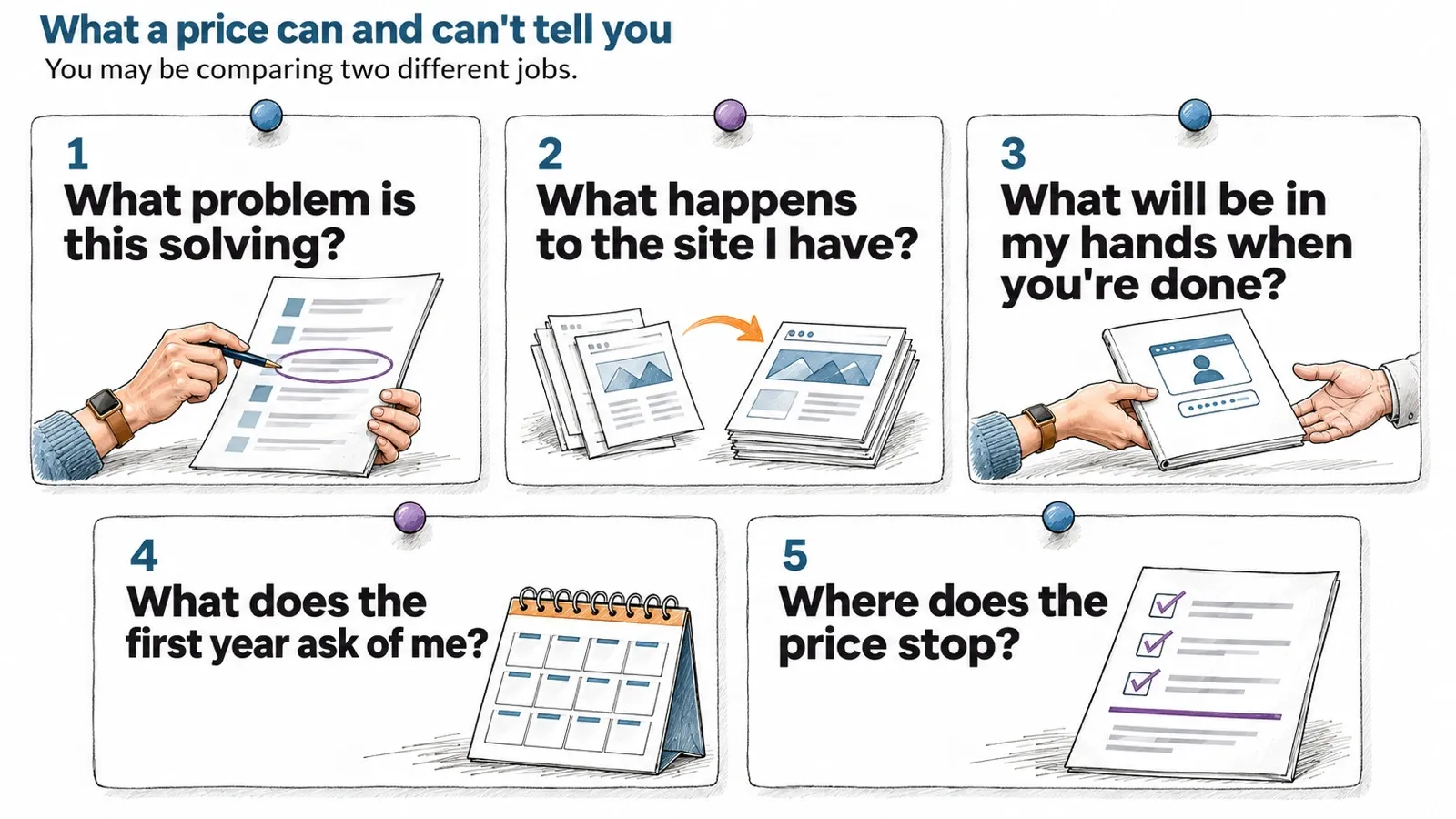
1. What problem is this solving?
Ask each person to name the problem in one sentence. Something like “people can’t find your programs on a phone” or “you can’t update the site yourself” gives you something to work with. “It needs a refresh” doesn’t tell you much.
If one new site is meant to fix your navigation and the other is meant to change how you sell your courses, you have quotes for two different jobs, and the totals aren’t prices for the same thing.
This is also the place to ask whether the problem could be fixed on the site you already have. If your site mostly works, the useful job may be smaller than a new one, and each person should be able to tell you why it is or isn’t. If what started all this was a comment that your site looks dated, that’s worth thinking through before you choose either quote.
Look for: one sentence about the problem, in words you would use, and a reason the current site can or can’t be fixed.
2. What happens to the site I have?
You aren’t starting from nothing. You have pages, posts, forms, maybe a store or a members’ area, and links to all of it from emails and other people’s sites. Someone has to decide what comes along, what gets left behind, and who does the moving.
Page addresses matter here. If the address of a page changes, Google’s advice is to match each old address to its new one and redirect it permanently, so anyone using the old address lands on the new page, and generally to keep those redirects for at least a year. Google also says to expect some temporary movement in rankings during that kind of move. If your addresses are staying the same, there may be very little of this work to do, which could be a fair reason for a lower price.
If search matters to your business, ask about it now. Google says a redesign is a good time to bring in search help, and the earlier the better. Even if you don’t bring in another person, talk about search before launch.
Look for: what moves, what doesn’t, whether any addresses will change, and who tests the forms and checkout before anyone else sees the new site.
3. What will be in my hands when you’re done?
A finished website is really several things that can live in several places. Your hosting or email can come from a different company than the one where your domain name is registered. Paying for the site doesn’t automatically put all of them under your control.
Start with the domain. The person or organization on record as the registrant holds the rights to that name, and is also responsible for keeping the account details current, along with the payment details if the domain renews automatically. If you don’t know who that is for your domain, check with the registrar, the company where it’s registered.
Then ask what kind of WordPress login you’ll have. They aren’t all the same. On a typical single site, an Administrator can manage users, plugins, themes and updates. Other logins can do less, so “you’ll have a login” isn’t a complete answer. If you aren’t sure which logins you should already have, keeping control of your website is a good place to start.
Then there’s who owns the work itself. In the United States, an independent contractor who creates a website or its content is generally the author and owner of that work unless there’s a signed written agreement that says otherwise. Your contract may already cover this, and software licenses are a separate matter. This is general U.S. information and not advice about your contract. If you can’t tell what yours says, an attorney can help.
Someone else holding an account for you isn’t automatically a problem. You may have agreed to it because you don’t want to deal with it. You just want to know that’s the arrangement, and how you’d get the account back.
Look for: whose name is on the domain and hosting, which login you’ll have, and a written line about who owns the finished work.
4. What does the first year ask of me?
You’ll be living with the site long after launch day, so ask who does what once it’s up.
The FTC’s advice for small businesses choosing a web host includes asking who keeps the software up to date and whether you can make changes yourself. It was written about hosts, but I’d ask anyone building a site the same two things. If you don’t know who does those jobs on your site now, this article on who looks after your website can help.
Ask about backups, too, and get a little specific. To fully restore a typical WordPress site you need both the database and the files, and getting a copy from a host can take time. Find out who is making the copy, where it’s kept, and who would put it back.
And then there’s everything you’ve written. Guidance for federal web teams treats launch as one stage and recommends assigning people to review the content afterward. A small business doesn’t need a federal process, but if the reviewing is going to be your job, it helps to know that before you say yes.
Look for: who handles updates, backups and small fixes, what that costs after launch, and which jobs are yours.
5. Where does the price stop?
You want to know what the price covers, and what it doesn’t, while you still have choices. Ask what isn’t included. Writing, photos, moving old posts, training and extra rounds of changes are all reasonable things to ask about. Then ask what happens if you need something more, and whether you’ll approve the cost before the work starts.
Read the promises as well. Some of them can be checked. Google lists questions you can ask about a page, including whether it displays well on a phone and is delivered securely. Accessibility is worth asking about, and a single score won’t settle it. The W3C says automated tools can’t check everything and human judgment is needed.
A promise of the top spot in Google is different. Google itself warns against ranking guarantees, and nobody quoting your site can guarantee it.
Look for: a list of what’s left out, how many rounds of changes you get, and how extra work is priced and approved.
Reading the replies
Put the two replies beside each other, one question at a time. You’re looking for answers that are clear and specific, in words you don’t have to look up.
A missing answer isn’t proof that someone is hiding something. They may do the work and never have thought to write it down. Ask again. If the second answer is still foggy, you still don’t know what that quote covers.
You may find that the lower quote covers everything you need. You may find that the higher one includes work you would have had to buy later. Or you may read both and realize that nobody has named a problem worth a new site. Choosing neither is a real answer.
The email to copy

Hi [Name],
Thank you for the proposal. Before I decide, I’m asking everyone I’m talking with the same five questions:
- In one sentence, what problem will this solve, and could it be fixed on the site I have now?
- What happens to my current pages, page addresses, forms and search listings?
- When you’re done, whose name will be on the domain and hosting, what level of login will I have, and who owns the finished work?
- During the first year, who handles updates, backups and small fixes, and what will that cost?
- What isn’t included, and how would extra work be priced and approved?
Short answers are fine. Thank you!
[Your name]
Before you sign either one
Send the email first. If the answers leave you wondering whether the site you have could be fixed instead, that’s where a Modernization Audit can help. I look at the WordPress site you have and tell you what to fix now, what can wait, and what you can skip. It’s for sites that are staying on WordPress. It isn’t a review of the proposals, and it doesn’t include a rebuild.
If you already know you need the new site, you don’t need the audit. Compare the answers first, then go back to the totals with the whole job in view.
Frequently Asked Questions
Is the cheaper quote a bad sign?
No, not by itself. It may cover less work, or it may come from someone with lower costs who covers the same work. The answers to the five questions will tell you more than the number does.
Do I own the site once I’ve paid?
Not necessarily all of it. The domain, the hosting account, the software licenses and the copyright are separate things. In the United States, paying an independent contractor doesn’t by itself transfer the copyright in what they made. Ask for the ownership terms in writing, and have an attorney read anything you’re unsure about.
Will a new site hurt my search results?
It can move them around for a while if your page addresses change. Google says to expect temporary ranking changes during that kind of move and recommends permanent redirects. Ask whether your addresses will change and who handles the redirects if they do. Nobody can promise where you’ll land.
Sources
- Google Search Central: Site moves with URL changes
- Google Search Central: Do you need an SEO?
- Google Search Central: Page experience
- ICANN: Registrant and general questions
- ICANN: Registrants’ benefits and responsibilities
- WordPress: Roles and capabilities
- WordPress: Backups
- U.S. Copyright Office: Circular 66
- FTC: Cybersecurity for small business, hiring a web host
- Digital.gov: Planning for the future of your content
- W3C: Selecting accessibility evaluation tools